

Can an ICE Agent be Charged? What the New Felony Assault Case in Minnesota Tells Us
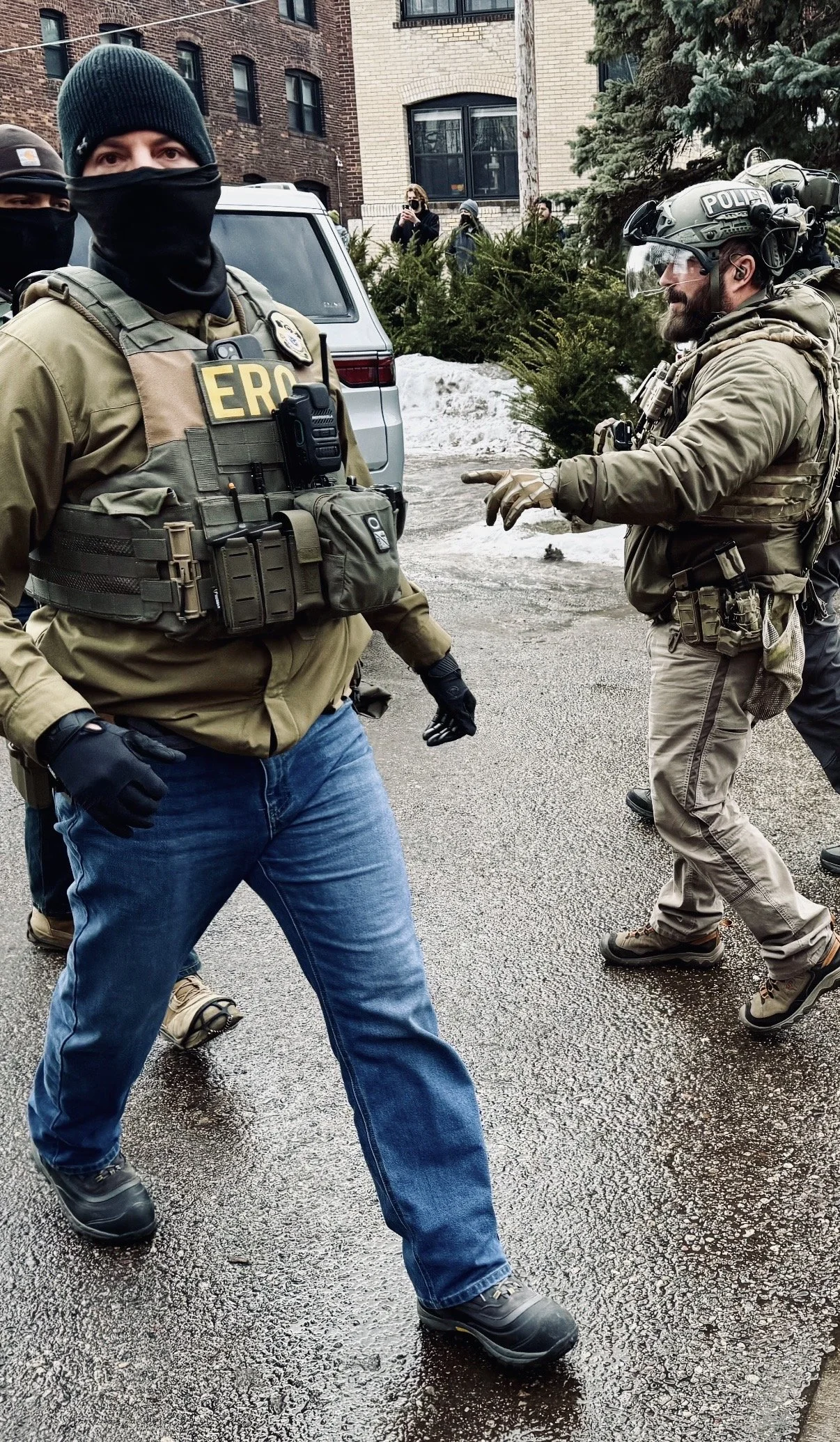
Photograph by Jack Rice during a Direct Confrontation with an U.S. ICE Agent on a Street in the Twin Cities
By Jack Rice, Criminal Defense Attorney, Former Minnesota Prosecutor, Former Federal Agent and Legal Commentator
With the State of Minnesota now charging an ICE agent with two counts of felony second-degree assault, a lot of people are asking a simple question:
Can the State Charge an ICE Agent? What about the Feds?
The answer is yes and yes—but the real story is how this plays out when both state and federal systems collide.
“A giant question is whether the Feds can stop the State from bringing charges?”
What Happened—and Why It Matters
According to prosecutors, the ICE agent is accused of pointing a firearm at two civilians during a highway incident in Hennepin County.
The State didn’t treat this as a minor issue. These are felony second-degree assault charges involving a dangerous weapon—serious allegations that carry the potential for significant prison time.
And that’s what makes this case different.
This isn’t an internal discipline issue. This is a full criminal prosecution.
Yes, the Feds Can Charge an ICE Agent
Federal agents are not immune from federal prosecution.
If an ICE agent violates federal law—whether it’s a civil rights violation, excessive force, or another federal offense—the U.S. Department of Justice can bring charges just like it would against anyone else.
That part is straightforward.
But Here’s Where It Gets Complicated
Now we have a situation where the State of Minnesota has already stepped in first, filing felony charges.
That raises two critical realities:
The state can prosecute violations of state law, even against federal agents even if the Feds refuse to do so.
The federal government can still bring its own charges if federal laws were violated
This means the same conduct could potentially be reviewed in two separate systems.
That’s not unusual in high-level cases—but it does raise the stakes dramatically.
The Real Legal Fight: Authority vs. Accountability
Having worked as both a prosecutor and a federal agent, I can tell you this is where the real battle begins.
The defense will likely argue:
The agent was acting under federal authority
His actions were tied to his role as law enforcement
The prosecution will argue:
This was not legitimate law enforcement activity
Pointing a firearm at civilians crossed a legal line
In fact, prosecutors have already suggested the conduct may have occurred outside the scope of official duties, which is a critical distinction.
Because once an action falls outside that scope, the legal protections for federal agents begin to disappear.
“When there is conflict between the two systems, who wins?”
Can Both Systems Move Forward?
Yes—and sometimes they do.
But in practice, federal and state authorities often coordinate. One system may take the lead, or the federal government may step in if there are broader constitutional or civil rights concerns.
What’s clear here is that this case is already testing the limits of how far federal authority extends in everyday situations, like a traffic encounter.
“Think Derek Chauvin, the former officer convicted in the murder to George Floyd. He was charged in both Federal Court and Minnesota State Court.”
Why This Matters?
I’ve spent my career enforcing the law—and now defending those accused under it.
And here’s the truth: the badge matters, but the law matters more.
Whether you’re a federal agent or a private citizen, the question is always the same:
Was the conduct lawful?
That’s what courts decide. That’s what juries weigh.
And that’s exactly what’s now in play in Hennepin County.
If You’re Facing Criminal Charges
Most people won’t face a case like this—but many will face serious criminal charges that can change their lives.
If you’re charged in the Twin Cities or surrounding counties, you need a defense that understands both sides of the system—how cases are built, and how they are challenged.
Contact Jack Rice Defense for a free, confidential consultation at 651-447-7650 or 612-227-1339.
Because when the stakes are this high, experience isn’t optional—it’s critical.